
How Arrest Warrants Work in White County
Magistrate Court in White County handles arrest, inspection, and search warrants as part of its criminal work. An arrest warrant tells law enforcement to take a named person into custody over an alleged offense. Before signing one, the magistrate weighs whether sworn facts add up to probable cause. The process can begin with police evidence or with a private criminal warrant application. White County guidelines ask whether the event happened in the county, whether it was reported, which Georgia offense is alleged, and what evidence or witnesses back up the account. From there, the court may give notice, order mediation, and hold a pre-warrant hearing before any arrest warrant issues.
White County Arrest Warrant Hearings
Filing a private application is not the same as having a White County arrest warrant. The paperwork simply asks Magistrate Court to weigh sworn facts. The official Magistrate Court page lays out the court's role, and local guidelines make the hearing's purpose plain: probable cause, not money damages or the return of property.
- The applicant states what happened, where and when it happened, and how the accused is known.
- The filing identifies reports, evidence, witnesses, and any prior application.
- Notice and a copy may go to the accused, and mediation may precede a hearing.
- The magistrate decides whether criminal process should issue.
A hearing notice in White County only means an application is pending, not that an active warrant exists.
Arrest Warrants: What They Contain
White County's application and first-appearance forms hold more than a name and a charge. Exact fields shift by stage. When requesting records, tell the clerk apart an application, an issued warrant, a service return, and the later criminal file.
| Court or agency number | A local identifier; no single public number format was documented. |
|---|---|
| Named subject | The person named, with identifiers officials use to prevent false matches. |
| Offense and facts | Alleged offense, date, place, narrative, victim, and classification. |
| Oath and decision | Affiant's oath and the magistrate's issuance decision, signature, and date. |
| Service and safety | Service request, witness blocks, prior applications, and safety flags. |
| Bond or appearance | Bond, commitment, first-appearance, or later court directions. |
White County Has No Live Arrest Warrant Roster
White County publishes no official arrest-warrant list, search box, or self-service warrant lookup, and Georgia has no central public warrant search either. The state warrant guidance points people back to the local sheriff. That road has limits. The Sheriff's Civil and Warrants page states warrant information is not given by phone, and the Records page lists a Records Clerk/Warrant Clerk, which is not a phone confirmation service. Checking your own status means following in-person instructions or filing a narrow records request. A relative may ask about releasable process, though one response cannot establish full clearance.
Access note: Absence from an inmate page, calendar, vendor result, or outside list does not prove that no White County arrest warrant exists.
How Warrants Get Served in White County
The Sheriff's Civil and Warrants Division serves arrest warrants from courts regardless of jurisdiction. The court issues process; the sheriff executes it. City police can act within their authority, and a routine law enforcement encounter can end with a warrant served. After arrest, the jail handles booking and bond logistics, and a person held without an existing bond may go before a magistrate. White County calendars list first appearance, committal, bond, arraignment, and pre-warrant mediation settings. Those calendars show court activity, not a live warrant roster. Official jail materials describe cash, property, professional, and recognizance routes. Property must meet county rules, staff cannot recommend a bondsman, and the published cash bond fee is $20 in exact change. Confirm current terms before surrender.
White County Arrest Warrant Path to Superior Court
A felony case in White County can start small. Magistrate Court handles the first appearance and the booking after an arrest warrant is served. From there, the matter may move up to the Superior Court in the Enotah Judicial Circuit. The Superior Criminal Division explains that a case opens after an arrest on a warrant or citation, then proceeds by accusation or indictment. Records along the way sit in several places: Magistrate Court, the sheriff, the jail, the Clerk's Superior Criminal Division, and the District Attorney. Dena Adams, Clerk of Courts, keeps the superior criminal files. Her office is at 59 South Main Street, Suite B, Cleveland, 706-865-2613, with criminal extensions 323 and 369. The District Attorney can be reached at 706-865-3306, and the official arrest-to-accusation workflow lays out the court's own account of the path.
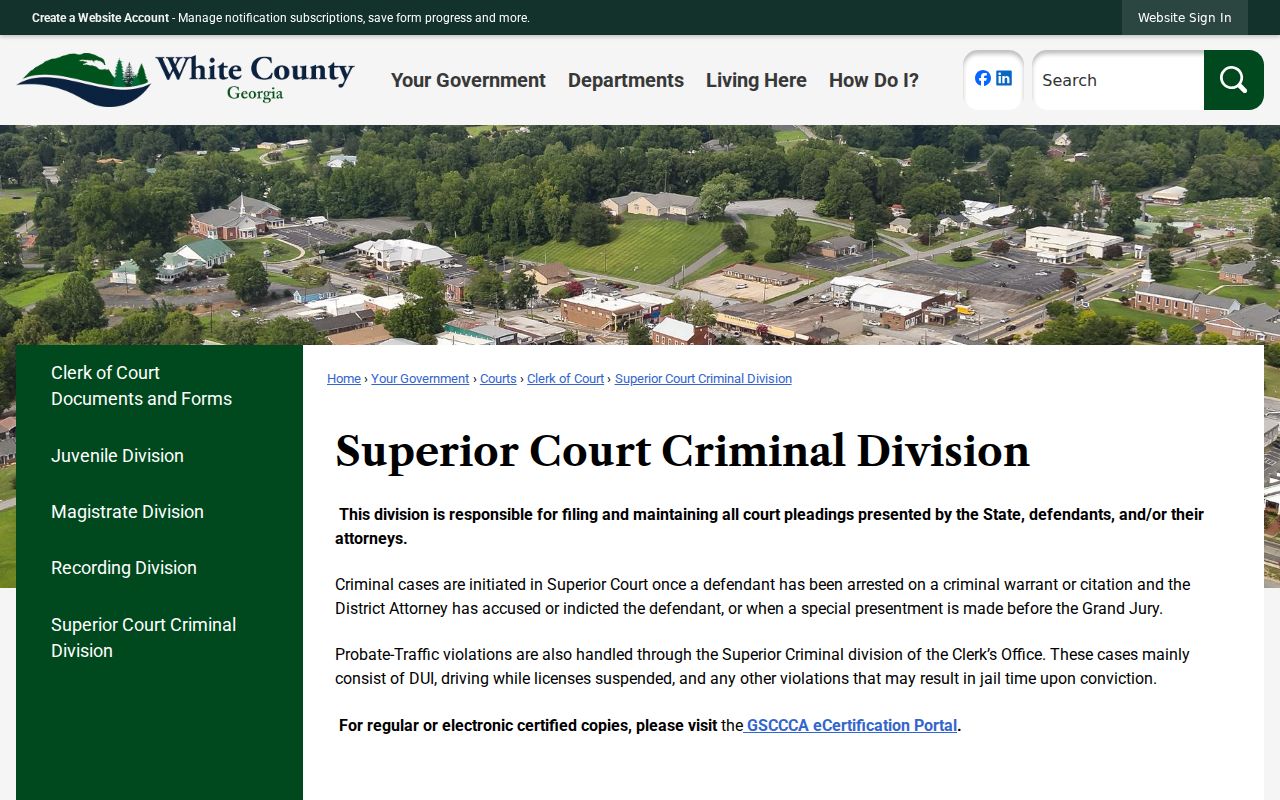
The path runs through White County Superior Court. Its docket shows how a case moves from arrest onward, with no live warrant result displayed.
Arrest Warrants, Summonses, and Bench Warrants
The labels matter in White County. Local courts call a missed-court command a bench warrant or an order for arrest, and the sheriff treats each label as the issuing record writes it. No separate public capias docket exists here.
| Process | Basis | Direction | Response |
|---|---|---|---|
| Arrest warrant | Probable cause | Authorizes arrest | Plan counsel, surrender, and bond |
| Summons or citation | Charge requiring response | Orders appearance | Follow the court date |
| Bench warrant | Missed duty or setting | Authorizes arrest for noncompliance | Ask issuing White County court about recall |
Missed a court date? The White County bench warrant lookup covers that process. The underlying case stays open even after the court adds a failure-to-appear response.
White County Arrest, Search, and Inspection Warrants
Magistrate Court in White County issues more than arrest warrants. Search and inspection warrants let officers search property or carry out an inspection. They do not target a person for arrest. The affidavits and execution records behind them can hold sensitive investigative facts, so Georgia law may permit redaction or withholding when disclosure would harm an investigation or expose protected information. Name the case, the date, the court, and the record type in any request. The Georgia Open Records Act, O.C.G.A. §§ 50-18-70 et seq., applies to existing public records, but it does not require an agency to create a report or answer a legal question. White County also treats juvenile information as confidential and unavailable from the Clerk. Read the paperwork carefully before drawing conclusions. A search-warrant return can document property seized or an officer executing judicial authority. That paper alone does not show the property owner was arrested or charged. An inspection warrant serves a different statutory purpose entirely. Ask for each document by its own title. Read the issuing language before attaching any status to a person. When a request touches an open investigation, the records office can explain that material is withheld without creating a public summary of the case.
Requesting Your White County Arrest Warrant Record
The Sheriff's records form covers only sheriff-held records, and it has no warrant checkbox. Choose “Other Records” and ask narrowly. Request your own status or service history, the issuing White County court, the case number, the issue date, the current status, and any releasable resolution directions. Add your full name, date of birth when appropriate, known numbers, and a short date range. The form lists Beverly O'Kelley at bokelley@whitecountyga.gov. Published fees run 10 cents per page, plus $29.42 per hour after the first 15 minutes. Another office may hold the file. If so, use the countywide form. An agency generally must provide available records within three business days or give a timetable and the fees. Pending investigations, protected identities, and juvenile material can still be withheld or redacted. Narrow wording cuts needless search time and cost. Status and disposition are different things, too. A served warrant may no longer be outstanding while its criminal case stays open. A recalled warrant can still appear in an older service record. Ask for the current status kept by the issuing White County court, the date of the latest action, and the releasable document that supports it. If the sheriff provides only its own return or service history, contact the issuing clerk for the court order. Service and judicial recall are separate acts in White County, so this two-office check is often needed.
For a relative, give only the details an accurate match requires and respect any relationship or authorization requirement on the form. Public access has limits. No agency will disclose every identifier, witness statement, safety flag, or investigative fact. A warrant request also does not grant permission to publish a roster. The purpose is civic. You are trying to understand a family member's official process and help route that person toward the issuing White County court, counsel, and lawful resolution. Keep the request narrow here too, and let White County staff point you to the right office.
Handling an Arrest Warrant in Your Name
Do not pay a caller who claims instant payment will erase a White County arrest warrant. The county fraud alert is blunt. The Sheriff will not call to announce warrants or outstanding citations and will not demand cryptocurrency. For a suspicious call, use 706-865-5177.
- Identify the court and exact case or warrant number.
- Speak with counsel before an in-person inquiry if custody is possible.
- Ask about voluntary surrender, first appearance, bond, and a motion to recall or quash.
- Verify current jail and approved bond rules.
- Confirm the final status with the issuing White County court.
Important: An in-person White County arrest warrant inquiry may lead to custody, so plan counsel, transport, identification, and bond arrangements first.
Georgia record restriction under O.C.G.A. §35-3-37 is a separate process and never recalls a White County warrant on its own.